Rock RiverVermont

Newfane · Windham County · Southern Vermont

Newfane, Vermont · Williamsville to the West River

History of the Lower Rock River

Before the Rock River reaches the West River, it tightens into one of the most layered stretches in Newfane. Ledge makes the pools. Old roads and bridge crossings shape the banks. Floods leave marks. Preservation keeps the corridor cared for.

The lower Rock River story is visible in the channel itself: ledge, pools, bars, bridges, flood marks, and trails.

In short

The short version

A ledge-controlled lower river

high

The final reach is not a soft, lazy river mouth. Ledge, pools, riffles, bars, bridge crossings, older channel work, and flood recovery all show up in a short stretch.

anr-t0201deep-research-report

A Williamsville-to-West River story

high

The clearest way to read the lower corridor is reach by reach, moving from the covered bridge and Williamsville area downstream toward the West River.

anr-t0201anr-t0204deep-research-report

A corridor changed by floods

high

High water belongs at the center of the history. Tropical Storm Irene cut off Williamsville and South Newfane, and town hazard planning still flags Rock River and Dover Road concerns.

A place shaped by roads and bridges

high

Depot Road, Route 30, Williamsville village roads, bridge crossings, and older roadbeds all help explain why this short corridor feels so layered.

A long-used swimming landscape

medium

The lower Rock River has long carried recreation, informal place names, mixed shoreline use, and a culture that depends on privacy and respect.

rrp-aboutdeep-research-report

A modern preservation effort

high

The protected lower corridor grew through user organizing, nonprofit formation, land purchase, conservation protection, management planning, and continued stewardship.

Study area

Where this history focuses

This page focuses on the lower Rock River corridor in Newfane, Vermont, especially the reach from the Williamsville area downstream to the West River. It is not trying to cover every tributary, road, or parcel in the full watershed.

The public story here centers on Williamsville, Duke Road, Depot Road, VT Route 30, Railroad Lane, Wildwood Acres Road, Old Pine Road, White Pine Lane, and the West River confluence. The coordinate range from the working research brief is latitude 42.9469 to 42.9580 and longitude -72.6724 to -72.6418.

Not every visible riverbank is public. For visiting, use the map of the lower river, plan a visit, and visitor guidelines.

Field guide

The lower river is easy to enjoy and harder to explain

On a map, the last run of the Rock River looks short. On the ground, it tells a bigger story: bedrock, glacial debris, village roads, a former dam, bridge crossings, flood repair, swimming culture, and a modern effort to keep the place cared for.

The broader Learn page gives the overview. This page slows down on the lower corridor itself, where the river makes its final run toward the West River.

ANR reaches

The lower river, reach by reach

The most useful way to read this part of the river is reach by reach. Vermont stream records break the lower Rock River into sections with different personalities. Together, they show a river narrowed, widened, straightened, flooded, and slowly reworked by its own current.

T02.04high

The approach reach

Covered bridge to Williamsville village

Just upstream of the village, the Rock River story tightens. The lower-corridor pattern starts to show: flood response, road influence, old channel traces, and village edges.

anr-t0204deep-research-report
T02.03high

The dam-legacy village reach

Williamsville village reach

Through Williamsville, the river runs in a narrow, lived-in corridor. Source notes tie this reach to ledge, pools, former dam influence, bridge constriction, and swimming use.

deep-research-report
T02.02high

The recovery reach

Downstream of Williamsville

Below the village, the river reads like a recovery reach. Older road influence, meadow-edge floodplain context, aggradation, and loss of floodplain access help explain its modern form.

deep-research-report
T02.01high

The ledge-and-confluence reach

Mouth reach at the West River

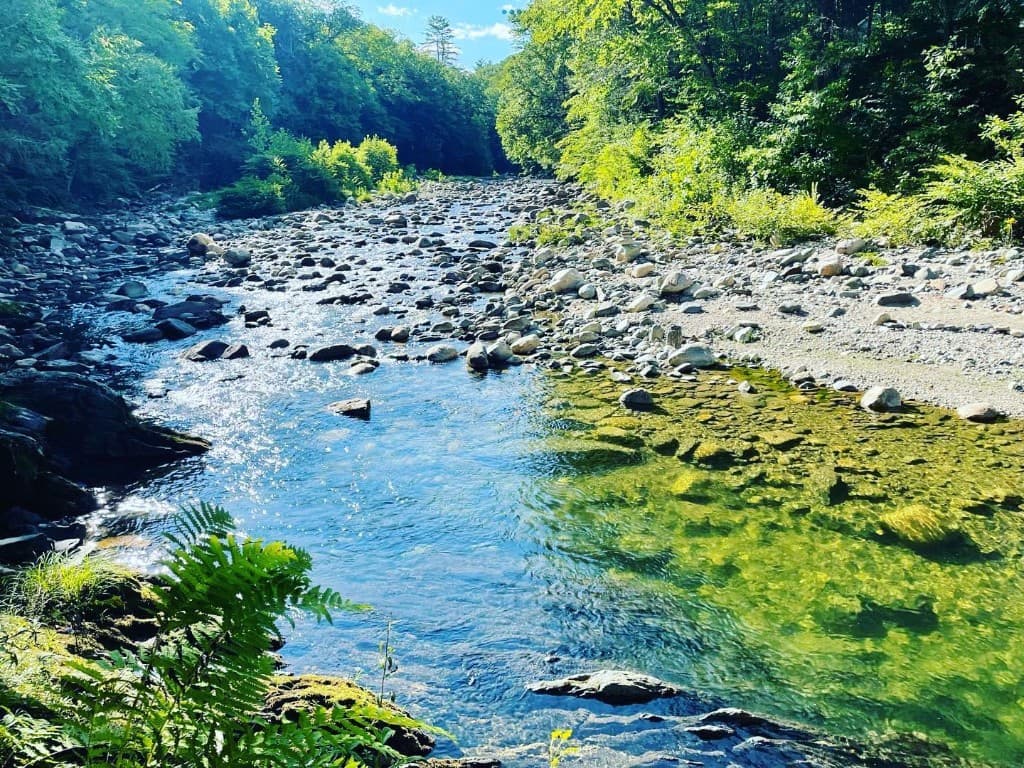
At the mouth, ledge becomes the main character. ANR records describe ledge outcrops, deep pools, riffles, widening, incision, and aggradation.

anr-t0201deep-research-report

Map evidence

What the maps reveal

The lower Rock River is not simply “wild” or “untouched.” Older maps and official reach notes point to straightening, road shifts, former roadbeds, bridge constrictions, dam effects, and flood response. That makes the lower river a record of natural force and human repair.

Historic topo maps

Show roads, bends, open land, channels, and older settlement patterns.

ANR geomorphic reaches

Give the strongest official record for ledge, pools, riffles, incision, and widening.

LiDAR hillshade

Can reveal terraces, road benches, flood chutes, and old channels when reviewed carefully.

Town hazard maps

Place floods, roads, bridges, and repair priorities in a public planning context.

Bridge project maps

Tie the river story to Depot Road and modern infrastructure work.

Preservation parcel documents

Explain protected land, conservation values, and stewardship limits.

Geology

Why the river feels so rocky

In the lower reach, bedrock is not just background geology. It helps make the pools, riffles, fixed bends, and ledge shelves. The mouth reach matters because ANR describes ledge outcrops creating deep pools and riffles.

Bend-by-bend bedrock claims still need GIS or field review. The public story can say the lower corridor is rocky and ledge-influenced without pretending every pool has already been mapped at outcrop scale.

Hydrology

Floods changed the corridor too

The Rock River belongs to the Connecticut River Basin and flows into the West River in Williamsville. A local watershed source describes the main stem as about 12 miles long and identifies the main stem, Baker Brook, and Marlboro Branch as the broader system. For this lower study area, Baker Brook is the named tributary best supported by the reviewed sources.

Floods are part of the history, not a side note. Tropical Storm Irene cut off Williamsville and South Newfane, and Rock River / Dover Road remains a continuing concern in town hazard planning. For day-of decisions, use current conditions.

Human history

Villages, mills, bridges, and swimming holes

The lower corridor belongs to a much older Indigenous homeland context, including Western Abenaki history in the region. This page does not claim a specific archaeological site in the lower reach without a public source.

Euro-American town history, Williamsville village life, roads, bridges, mills, fields, and later recreation all left marks. Informal names for pools and banks belong in the story, but they should be handled with privacy, dignity, and care rather than turned into spectacle. See the visitor guidelines for behavior norms.

Preservation

How preservation became part of the story

Preservation here did not start as an abstract idea. It grew from people using the river, seeing the pressure on it, and deciding the lower corridor needed care, rules, repair, and protected land.

Rock River Preservation sources describe organizing around 2000, nonprofit formation in 2005, a 2007 purchase of about 4.5 acres, a conservation easement relationship, a 2018 expansion, and later management planning. The reason still feels practical: access, erosion, litter, habitat, privacy, trail repair, and respectful use.

Learn about preservation work.

Timeline

A timeline written into the river

Deep timegeologymedium

Bedrock sets the hard frame

Long before roads, bridges, or swimming holes, regional metamorphic bedrock gave the future river a hard frame. The public story can explain that frame without claiming bend-by-bend geology until GIS or field review supports it.

deep-research-report
After the last ice ageglacial historymedium

Ice and meltwater reshape the valley

Glacial scouring, till, boulders, meltwater, and later river incision help explain why the lower corridor mixes ledge, bars, benches, and steep valley edges.

deep-research-report
Before colonial settlementindigenous contextmedium

Indigenous homeland context

The corridor sits within the broader homeland and travel landscape of Indigenous peoples, especially Western Abenaki context. The page does not claim a documented archaeological site in this exact reach without a public source.

deep-research-report
1761 to 1766settlementhigh

Newfane is rechartered and settled

Euro-American town history begins here, then later connects to the villages, roads, mills, farms, and river crossings of the West River valley.

deep-research-reportnewfane-town-plan-2018
1800ssettlementhigh

Mills, bridges, roads, and village life grow around the river

Williamsville and the lower Rock River became part of a working village landscape. Water power, roads, bridges, fields, and later rail connections shaped how people moved through the valley.

deep-research-report
1870sroads and bridgeshigh

Williamsville Covered Bridge era

The covered bridge remains one of the clearest surviving landmarks for the Rock River’s road and village history.

deep-research-report
1935 to 1954map evidencehigh

Maps show a changed corridor

Historic map comparison points to road and channel changes in the lower corridor. That evidence turns the river from scenery into a readable record.

deep-research-report
1973floodhigh

A major flood reshapes the watershed response

The research brief connects the 1973 flood to later dredging, berming, and channel work in the watershed. Treat this as watershed-scale context unless a record ties a specific action to a named lower-reach site.

deep-research-report
1980sriver usemedium

A former Williamsville dam fades from the active river story

The report describes a former wooden dam in Williamsville that appears to have disappeared from the active channel story by the 1980s.

deep-research-report
2000preservationhigh

Users begin organizing around preservation

The modern preservation story begins with people who used the river and saw the pressure on access, privacy, litter, erosion, and respectful shoreline norms.

rrp-aboutdeep-research-report
2005preservationhigh

Rock River Preservation becomes a nonprofit

This milestone gives the access and stewardship effort a formal nonprofit structure.

2007preservationhigh

The first riverfront parcel is protected

Rock River Preservation purchased about 4.5 acres of riverfront land, with conservation protection connected to Vermont Land Trust.

2011floodhigh

Tropical Storm Irene changes the local flood memory

Irene cut off Williamsville and South Newfane and left continuing flood and erosion concerns around Rock River and Dover Road.

2018preservationhigh

Preservation expands to the hillside parcel

The protected and stewarded area expanded through another purchase. Exact deed-level details should stay with land records and management documents.

rrp-aboutdeep-research-report
2021 to 2023modern stewardshiphigh

Management planning gets updated

Management planning turns preservation into daily care: trails, erosion, habitat, litter, access, and respectful use.

rrp-management-plan-2021deep-research-report
2022roads and bridgeshigh

Depot Road Arch Bridge replacement

Bridge work at Depot Road shows how modern infrastructure still has to answer to the Rock River’s steep, active corridor.

Field guide

What to notice on the ground

Observe only from legal public access points, posted trails, and public roads. Do not trespass, collect rock, remove plants, disturb artifacts, or walk off signed routes.

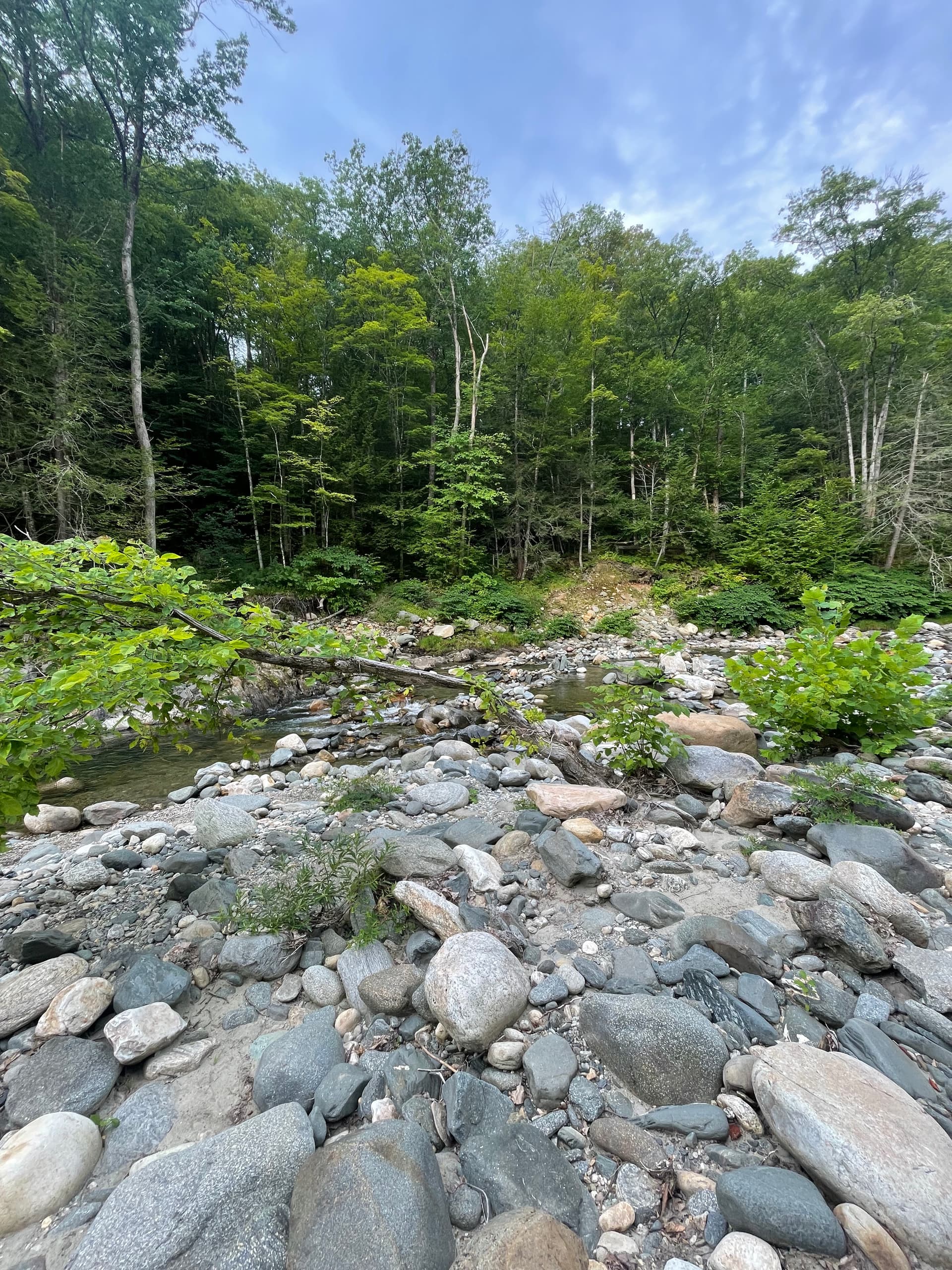
  • Stream-polished ledge, deep pools, riffles, rounded cobbles, and gravel bars.
  • Bars and islands that show where the river slows or drops sediment.
  • Flood debris lines, cut banks, eroding edges, and repaired or worn trails.
  • Bridge constrictions, road benches, old channel traces, and visible land-use clues.
  • Seeps, wet spots, tributary mouths, and terrace edges above the active channel.

Research notes

What is well known, and what still needs checking

High confidence

  • The lower reach is ledge-controlled in places.
  • T02.01 has deep pools and riffles tied to ledge.
  • Williamsville and South Newfane were cut off during Irene.
  • Depot Road Bridge 12 is a documented Rock River crossing.
  • Preservation history has strong organization sources.

Needs more record work

  • Exact parcel-by-parcel ownership: The broad preservation story is public, but a definitive parcel table for both banks needs deed and lister-card review.
  • Exact bedrock unit beneath every lower bend: Regional geology supports the public explanation. Bend-by-bend mapping should wait for GIS overlay or field geologic review.
  • Corridor-specific Indigenous archaeology: Use broader Abenaki homeland context, but do not claim a documented site in the lower corridor without a public source.
  • Historic informal names: Informal swimming-hole names should be treated as living local language, not formal map names, unless source-backed.

FAQ

History questions people ask

Where is the lower Rock River?

This page focuses on the lower Rock River corridor in Newfane, Vermont, especially the reach from the Williamsville area downstream to the West River.

Where does the Rock River meet the West River?

The Rock River reaches the West River near the lower Newfane corridor around Route 30 and Depot Road. Use map and visitor guidance rather than private-property assumptions.

Why does the lower Rock River have deep pools?

Official stream-geomorphic records for the mouth reach describe ledge outcrops, deep pools, riffles, widening, incision, and aggradation. Bedrock helps frame several parts of the lower river.

What is special about the Williamsville reach?

Williamsville sits where river, road, bridge, village, former dam influence, flood response, and swimming culture overlap in a short corridor.

What happened during Tropical Storm Irene?

Newfane hazard planning records that Tropical Storm Irene cut off Williamsville and South Newfane and left continuing flood and erosion concerns around Rock River and Dover Road.

What land is preserved?

Rock River Preservation describes organizing around 2000, nonprofit formation, a 2007 riverfront purchase of about 4.5 acres, conservation protection, and later expansion. Exact parcel boundaries belong in official records.

Is the whole riverbank public?

No. Not every visible riverbank is public. Visitors should use posted, legal, and clearly public access routes and follow current site guidance.

Is this an official town or agency page?

No. RockRiverVT is an independent visitor guide. It links to official plans, maps, nonprofit materials, and public records so readers can check the source trail.

What sources is this history based on?

The page uses Vermont ANR stream geomorphic records, Newfane planning and hazard documents, VTrans bridge materials, Rock River Preservation documents, Vermont Land Trust material, local watershed context, and a working research synthesis.

Sources

Sources and research notes

This page uses official stream records, town planning documents, bridge project materials, conservation records, public nonprofit materials, watershed context, and a working research synthesis. It stays cautious where deed, GIS, archaeological, or informal-name questions need more review.

high reliabilityofficial

Newfane Hazard Mitigation Plan 2024

Town of Newfane / Windham Regional Commission

Town-level flood, erosion, road, river, and Tropical Storm Irene context for Newfane, Williamsville, and South Newfane.

high reliabilityofficial

Newfane Town Plan 2018

Town of Newfane

Town character, conservation, land-use, and natural resource planning context.

high reliabilityofficial

Depot Road Bridge 12 Fact Sheet

Vermont Agency of Transportation

Bridge 12 over the Rock River, including 1908 arch bridge context and replacement project details.

medium reliabilitylocal

Marlboro Mixer, Sept-Oct 2021

Town of Marlboro

Useful watershed overview for the Rock River main stem, Baker Brook, Marlboro Branch, and Connecticut River Basin context.

high reliabilityconservation

About Rock River Preservation

Rock River Preservation

Organization history: user organizing, nonprofit formation, first purchase, easement relationship, and expansion overview.

high reliabilityconservation

Vermont Land Trust Report

Vermont Land Trust / Rock River Preservation

Conservation values including shoreline, woodland, open land, wildlife habitat, and natural resource protection.

medium reliabilitylocal

Lower Rock River Deep Research Report

Working synthesis supplied for this page. Use for structure and leads; keep public claims tied to source confidence.

For broader site context, see broader overview, source list and maps, and river photos.