Rock RiverVermont

Newfane · Windham County · Southern Vermont

Water quality

Rock River VT Water Quality

Recreational rivers can carry microorganisms like E. coli, and water quality can change quickly with rain. Testing helps build context, but results are not real-time. Use this guide to understand what the numbers mean, why rain matters, and where to check official data before you swim.
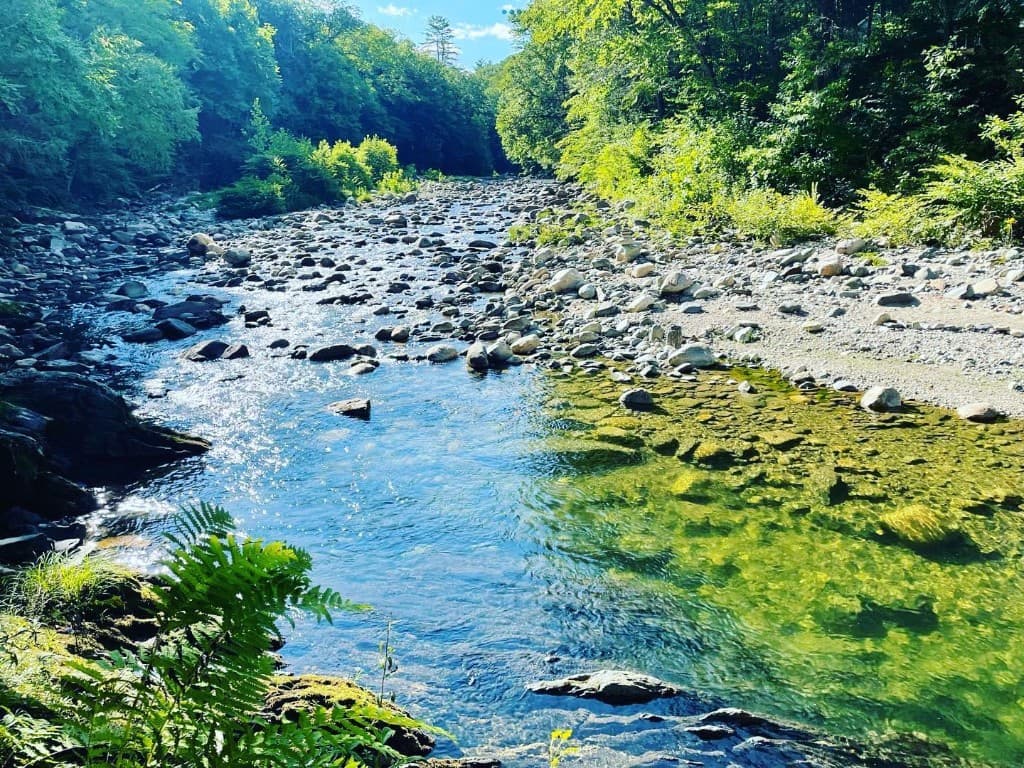
Clear water in the rocky pools of Rock River, Newfane Vermont, framed by forest
Clear water is reassuring but not proof of clean water—E. coli is invisible, and rain can change the river quickly.

Know before you go

Parking
Use marked Route 30 pull-offs near Depot Road. If legal parking is full, choose another plan.
Trail
Expect uneven rock, roots, mud after rain, and slick ledges. Wear shoes with grip.
Water
No website clears a river for swimming. Read flow, clarity, weather, and your own exit route.
Facilities
No restrooms, showers, trash cans, vendors, or on-site services at the river.
Cell service
Open the map and save directions before arriving. Signal can be weak in the corridor.
Privacy
Do not photograph strangers. Skip loud shoots and give people space on the bank.
Dogs
Leash and pick up when land rules and neighbors require it. Follow any posted dog rules.
Pack out
Carry out everything you carry in, including small trash.
Lifeguards
There are no lifeguards. You are responsible for your own read of the water.
Best season
Many visitors use warm months for swimming; conditions still change daily—check before you go.

Plain answer

Is Rock River safe to swim today?

No website—including this one—can confirm that Rock River is safe to swim on any given day. Water quality is not monitored in real time, and a single test result is only a snapshot from one spot at one moment. The most reliable plan is to check recent rainfall, read flow and clarity from the bank in person, and choose another day if conditions look off.

This page is an independent visitor guide. For official stewardship, public access, volunteer onboarding, posted rules, or management decisions, see Rock River Preservation and posted signs on site. For weather, flood, river, and public-health context, compare this guide with official and regional resources.

For the broader “should I get in?” decision—flow, cold water, slick rock, and your own exit route—pair this page with Water Safety and today’s Conditions.

The basics

What E. coli testing means

E. coli is used as an indicator organism. High levels do not always mean the bacteria itself will make you sick, but they signal that fecal contamination—and the pathogens that can travel with it—may be present. Vermont health guidance explains that testing helps determine whether recreational water is reasonable for swimming.

Samples are typically collected during the recreation season, sent to a lab, and reported after processing. That means every published number describes the water as it was when the sample was taken, not the water you are standing in.

Why timing matters

Why rain changes the answer

Vermont River Conservancy notes that water quality can change quickly with rain and recommends avoiding swimming after heavy rain. Rainfall washes bacteria, sediment, and runoff from roads, fields, and septic systems into the river. It can also raise flow and speed, hide debris, and make ledges slick.

A common planning baseline is to wait at least 24 to 48 hours after heavy rain, and longer after flooding. For storm-specific guidance, read Rock River after rain.

Common myth

Why clear water is not a guarantee

E. coli and other microorganisms are invisible to the eye. Water can look clear and still carry elevated bacteria, and it can look slightly cloudy while remaining within a normal range. Clarity is a useful clue—sudden brown or turbid water often follows runoff—but it is not proof that the water is clean.

Official data

Where to check official testing

Sampling programs publish results after collection, so treat them as seasonal context rather than a live signal:

Checklist

What to do if there has been heavy rain

  • Default to no swim for at least 24–48 hours; longer after flooding.
  • Watch for brown, fast, or foamy water and floating debris.
  • Check the most recent published sampling result for season context.
  • Read the bank in person—footing, current, and your exit route.
  • If in doubt, walk the trail and save the swim for a clearer day.

Common questions

Rock River water quality FAQ

Is Rock River safe to swim today?
No website can clear a river for swimming today. Water quality is not measured in real time, and conditions change fast after rain. Check recent rainfall, look at flow and clarity from the bank, and skip the swim if anything looks off.
Is Rock River E. coli testing real-time?
No. Samples are collected periodically during the recreation season and results are not live. A past clean result does not confirm the pool in front of you is clean right now, especially after rain.
How long should I wait to swim after heavy rain at Rock River?
Vermont health guidance suggests waiting at least 24 to 48 hours after heavy rain, and longer after flooding. Rain washes bacteria and runoff into the river and can raise flow and hide debris.
Does clear water mean Rock River is clean?
Not necessarily. E. coli and other microorganisms are invisible. Water can look clear and still carry bacteria, and it can be cloudy yet within normal range. Clarity is one clue, not a verdict.